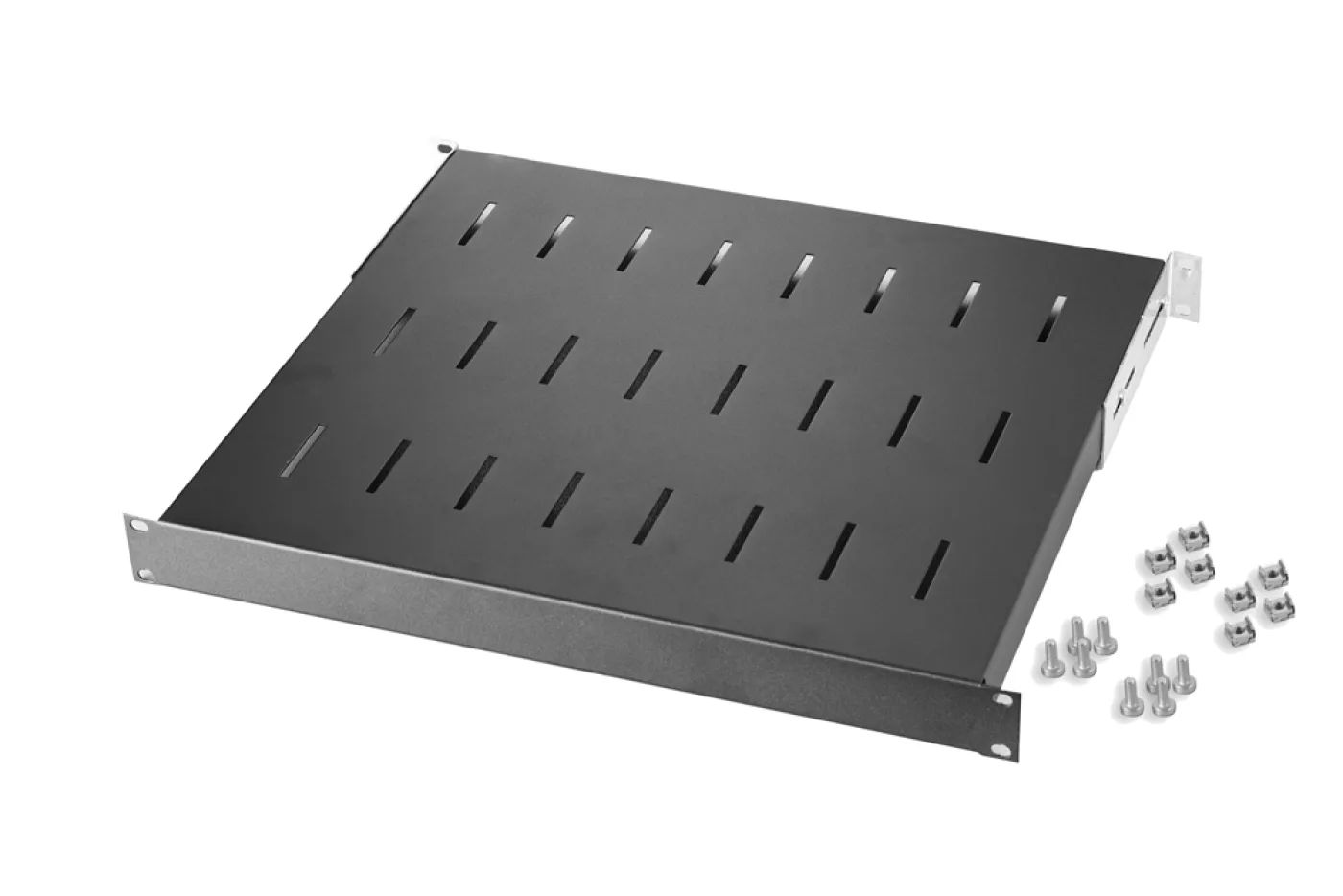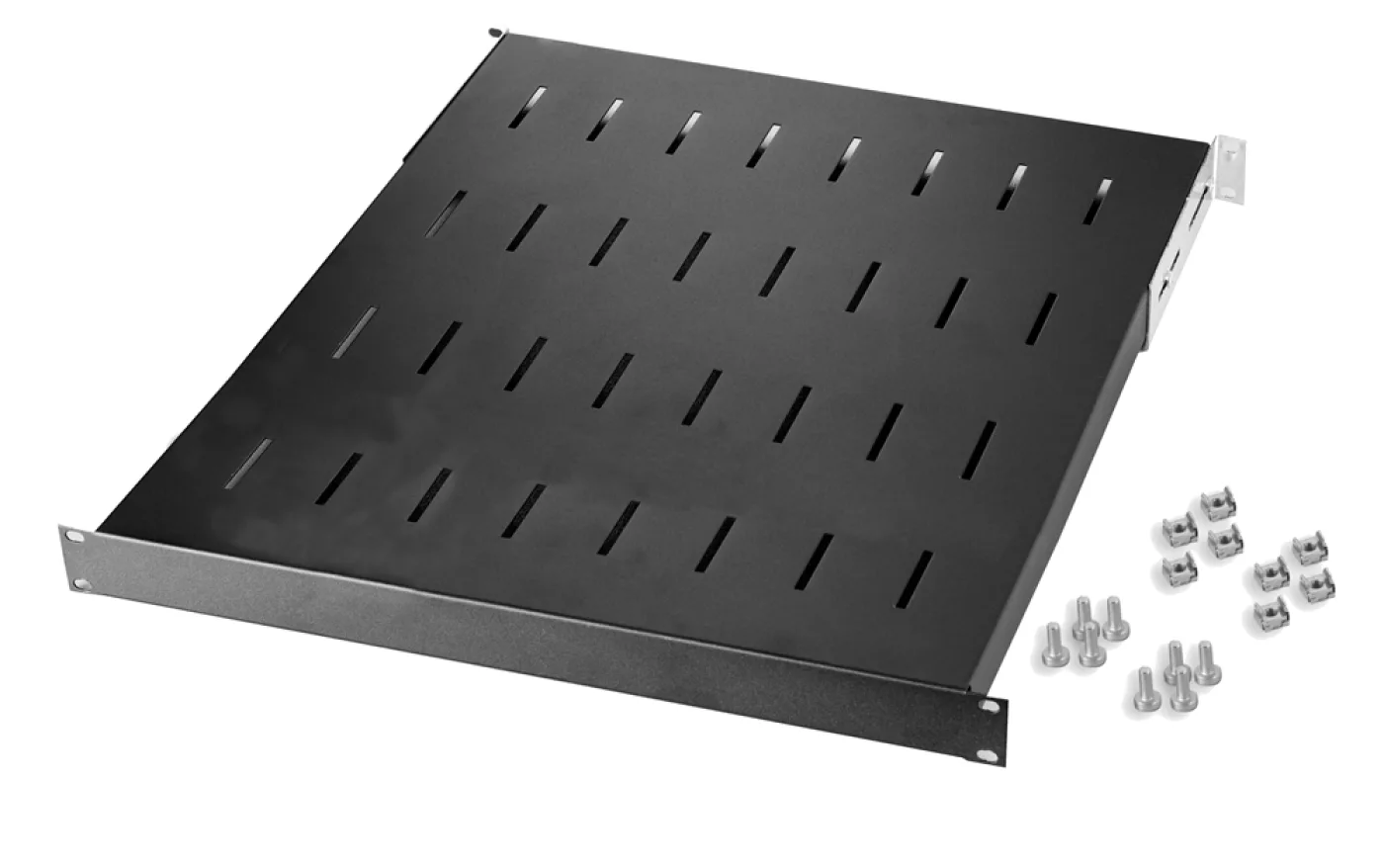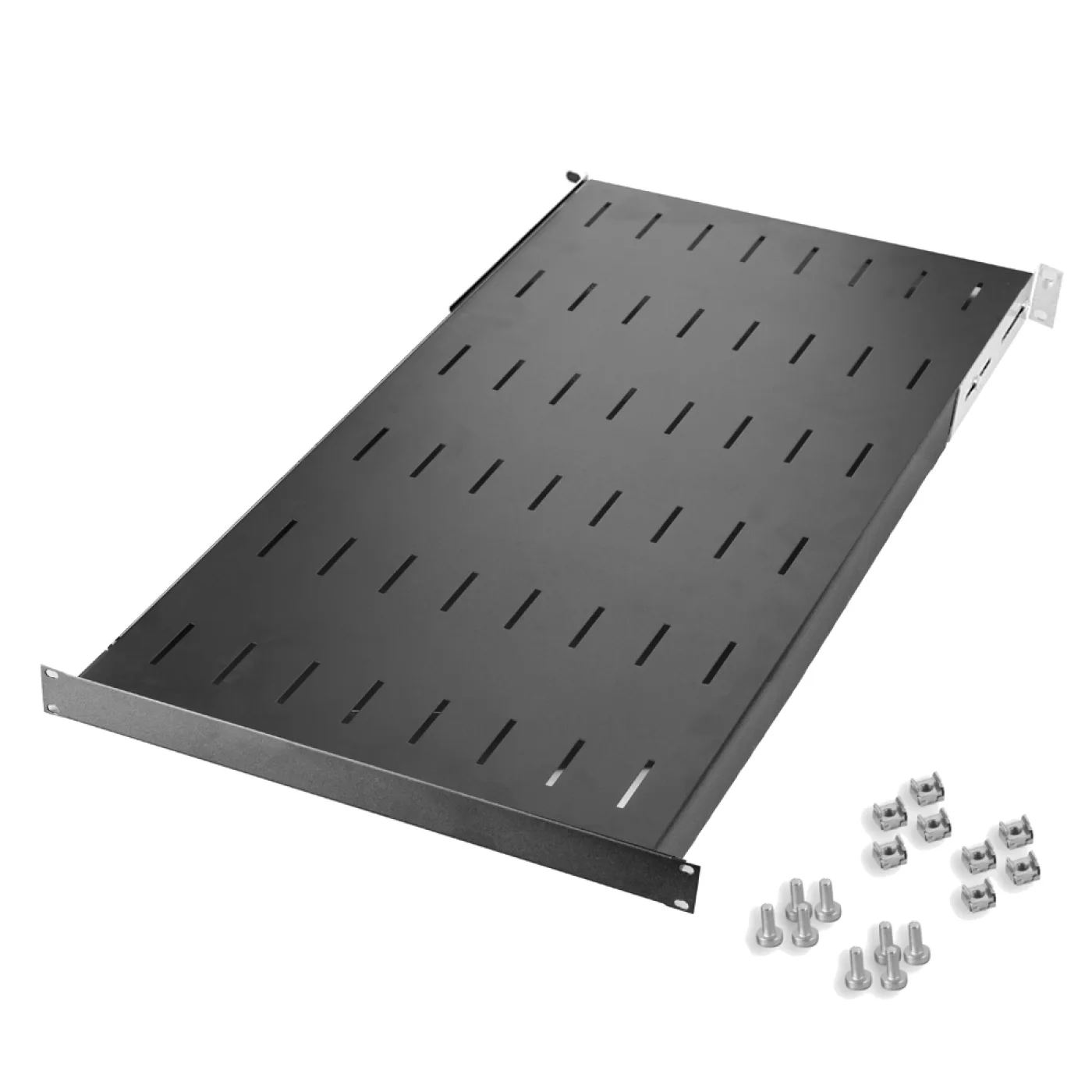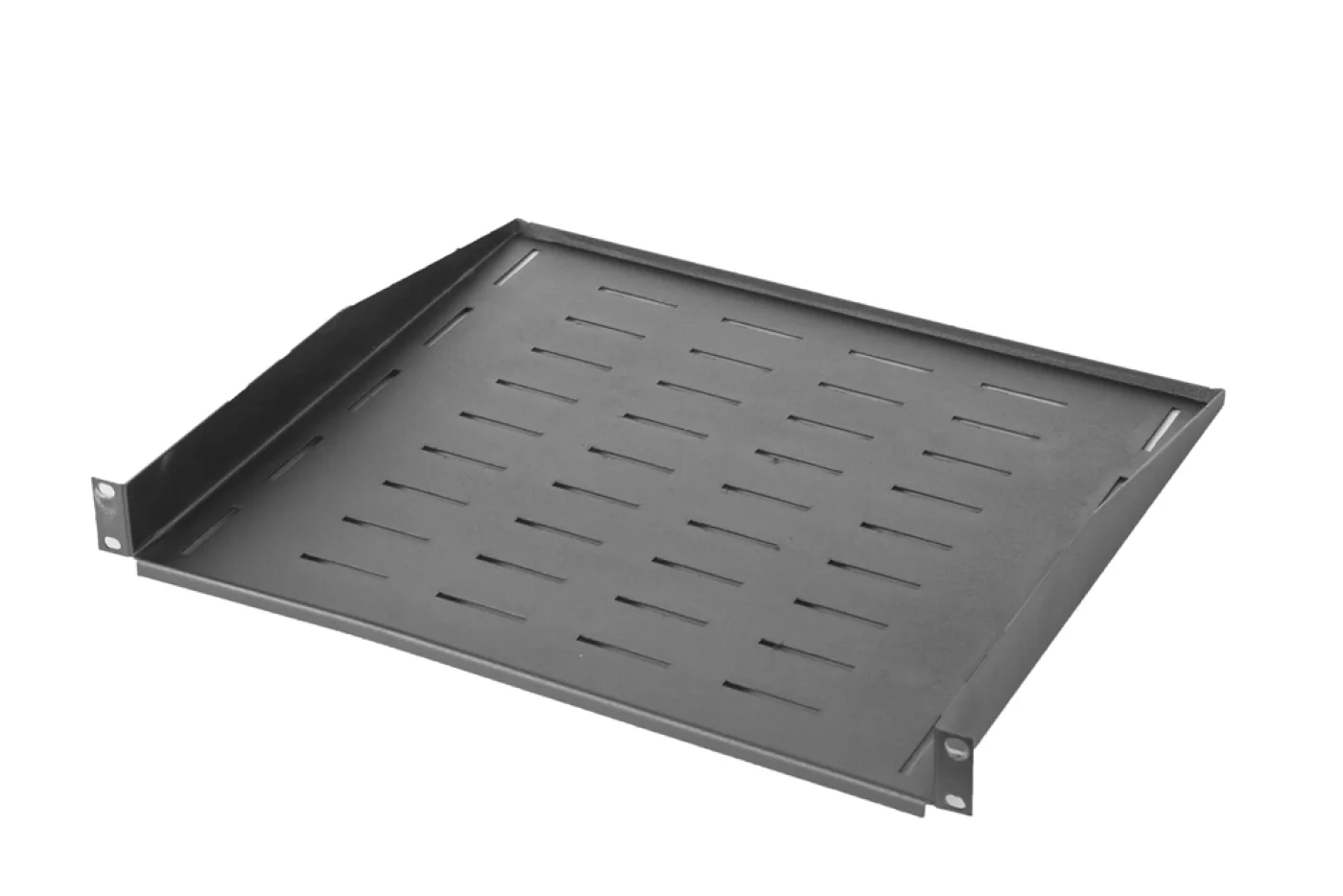
Not everything that goes into a rack is made for 19-inch mounting. A desktop switch, a media converter, a modem, a small NVR, an external drive enclosure — all of them go on a shelf. A mistake in choosing that shelf comes back six months later as a sheet of steel bent in the middle.
Three types, one mechanical difference
What separates the shelves is not their appearance but how they attach to the cabinet. The entire difference in load capacity follows from that.
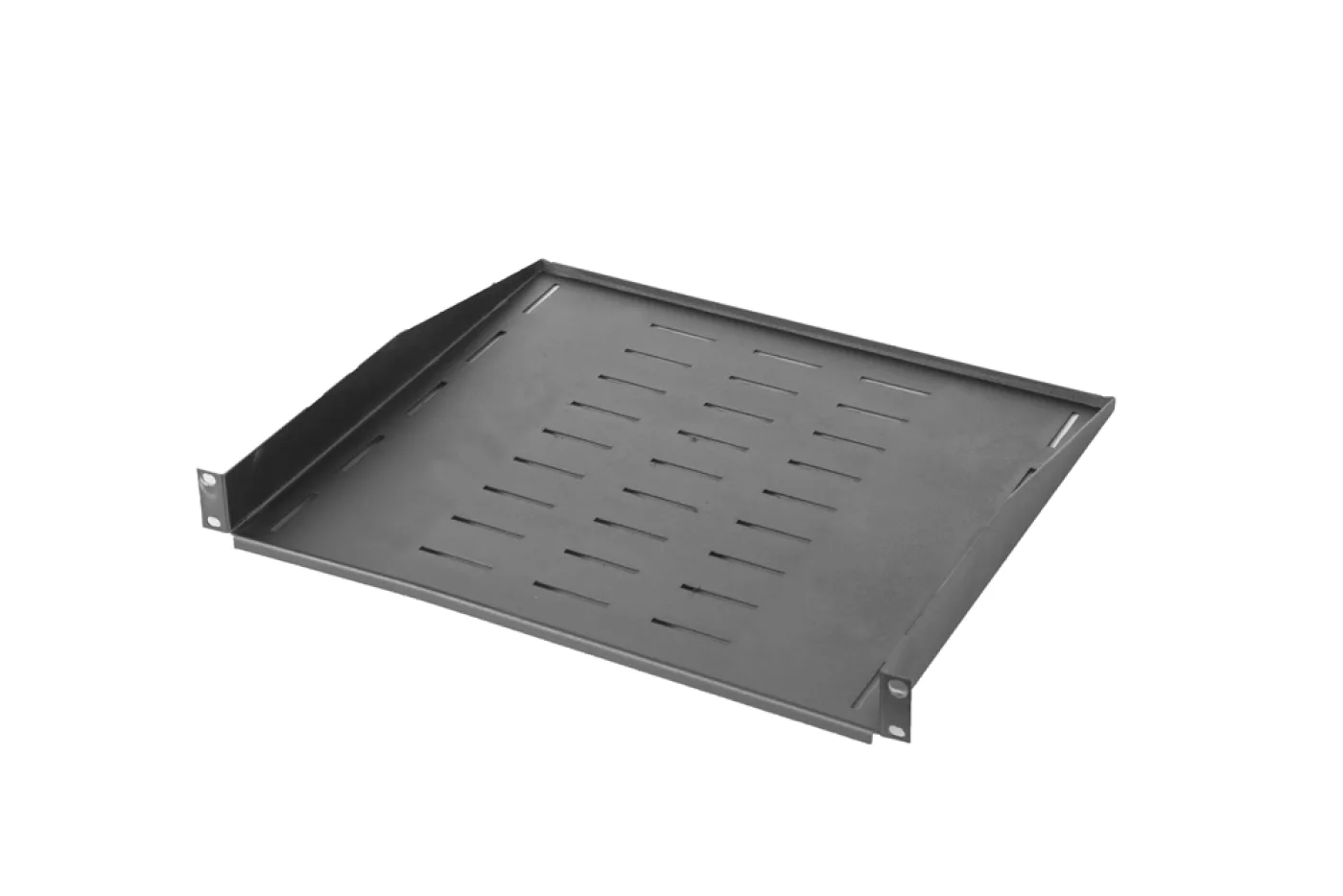
Cantilever shelf
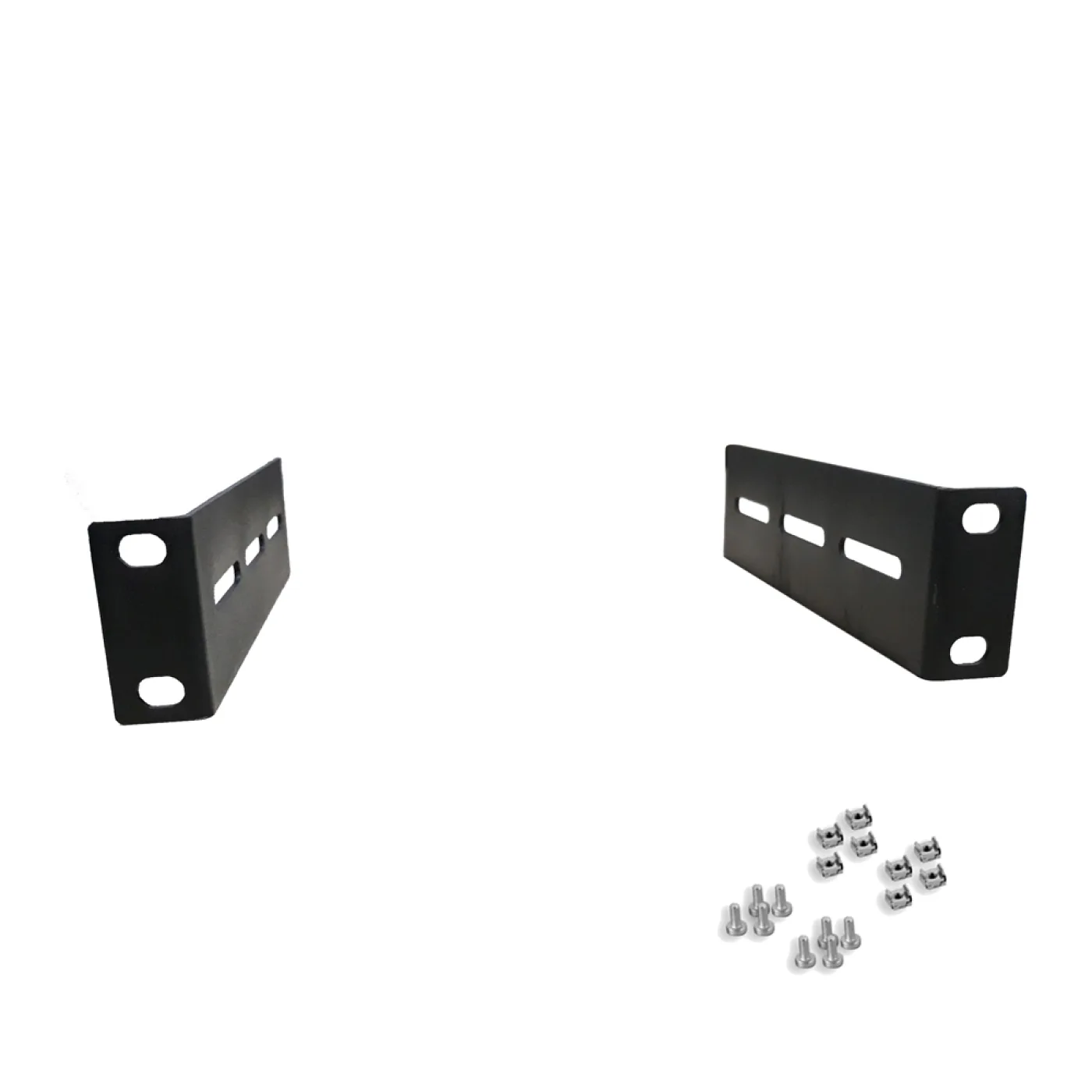
It bolts to the front posts only; the back is unsupported. It behaves as a cantilever beam: the further forward the load sits, the greater the moment at the posts. That is why cantilever shelves are both shallower (300 and 400 mm in our catalogue) and intended for lighter loads.
Where it is right: in cabinets with no rear posts or no rear access, in shallow wall-mount cabinets, and where the equipment going on it is light.
Fixed shelf
It spans front to rear and bolts at four corners. The load is shared between two pairs of posts and the moment arm is short. For the same sheet thickness it carries markedly more than a cantilever.
Where it is right: in floor-standing cabinets, under heavier equipment, in permanent installations. Our catalogue offers 400, 500, 600 and 800 mm depths.
Sliding shelf
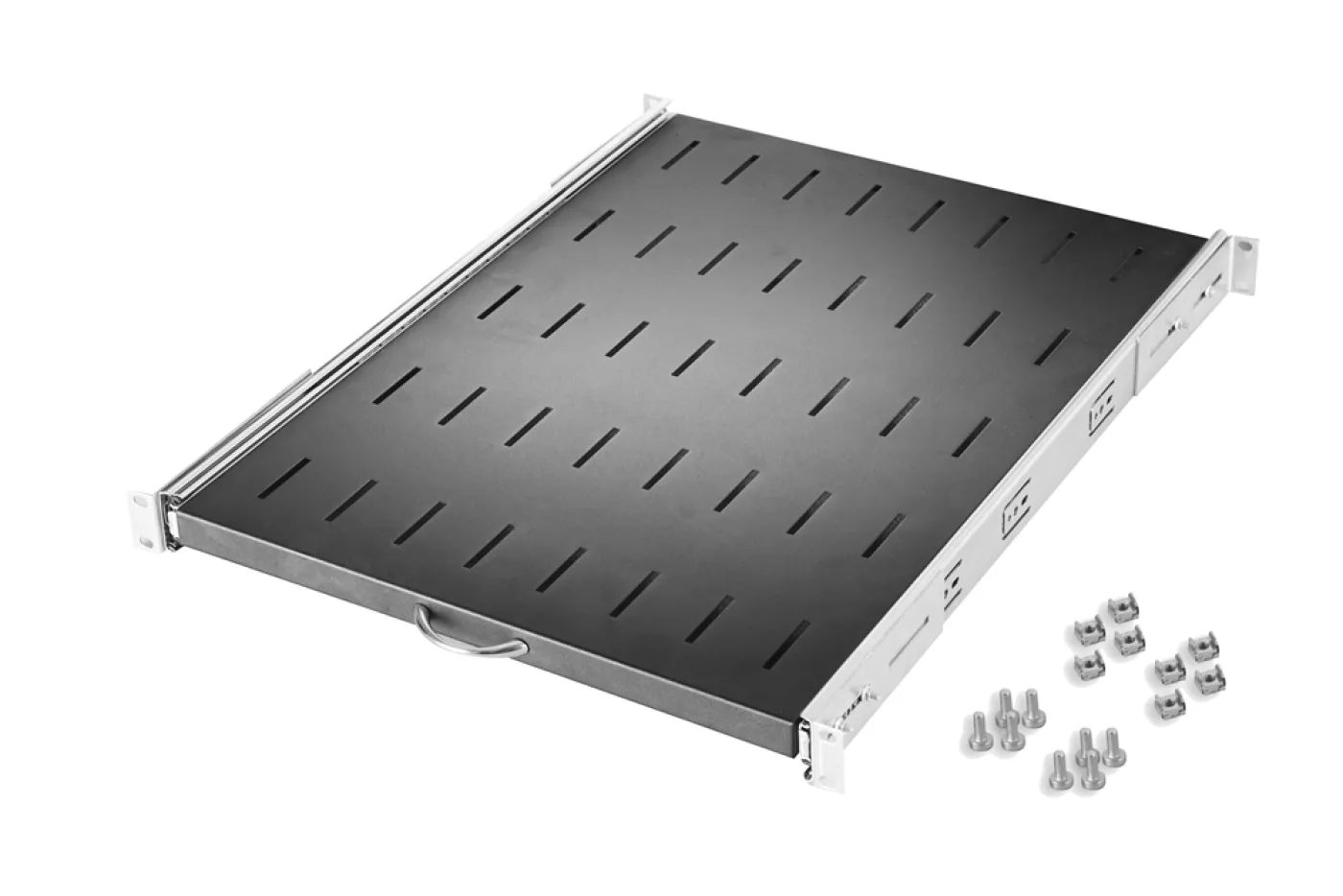
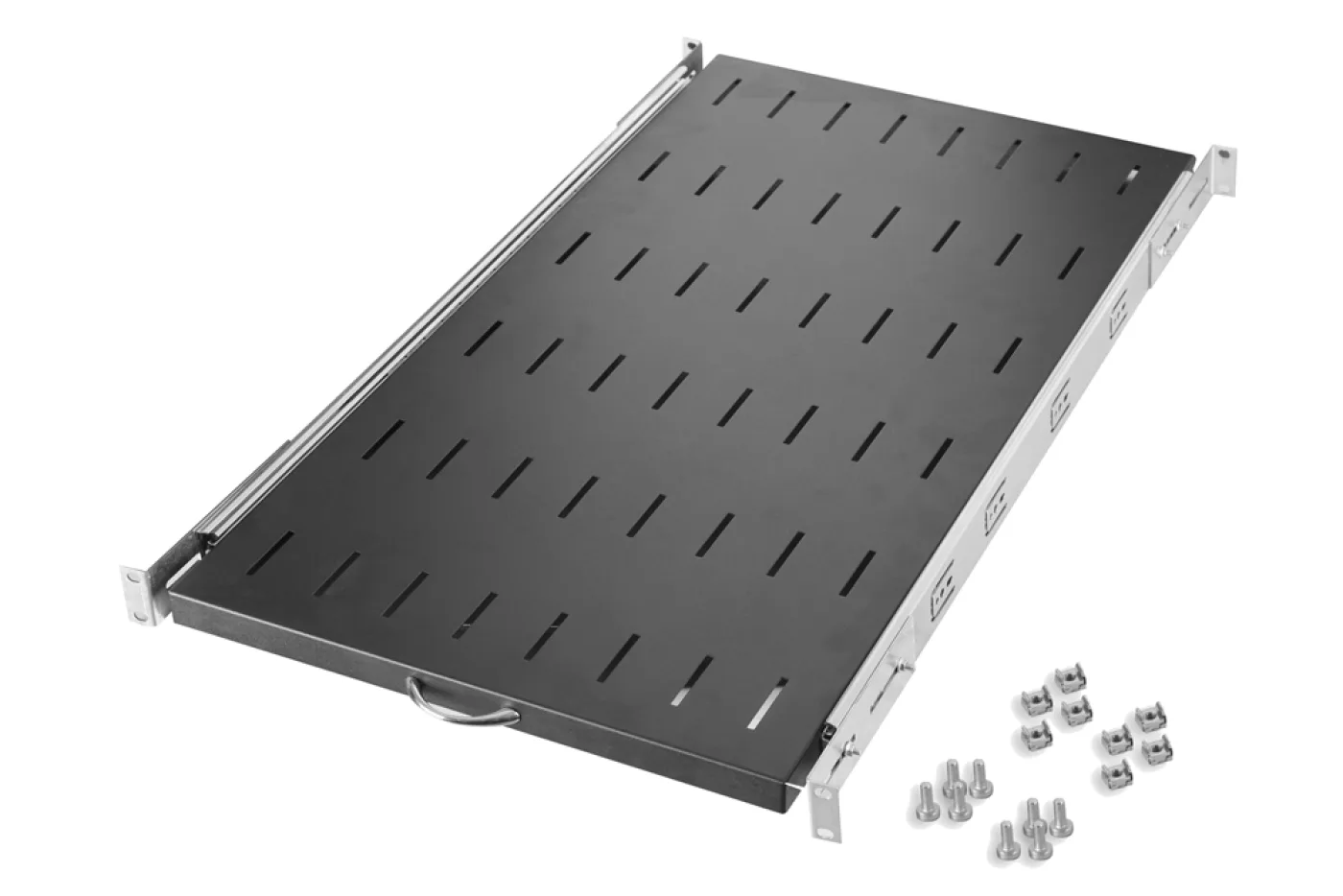
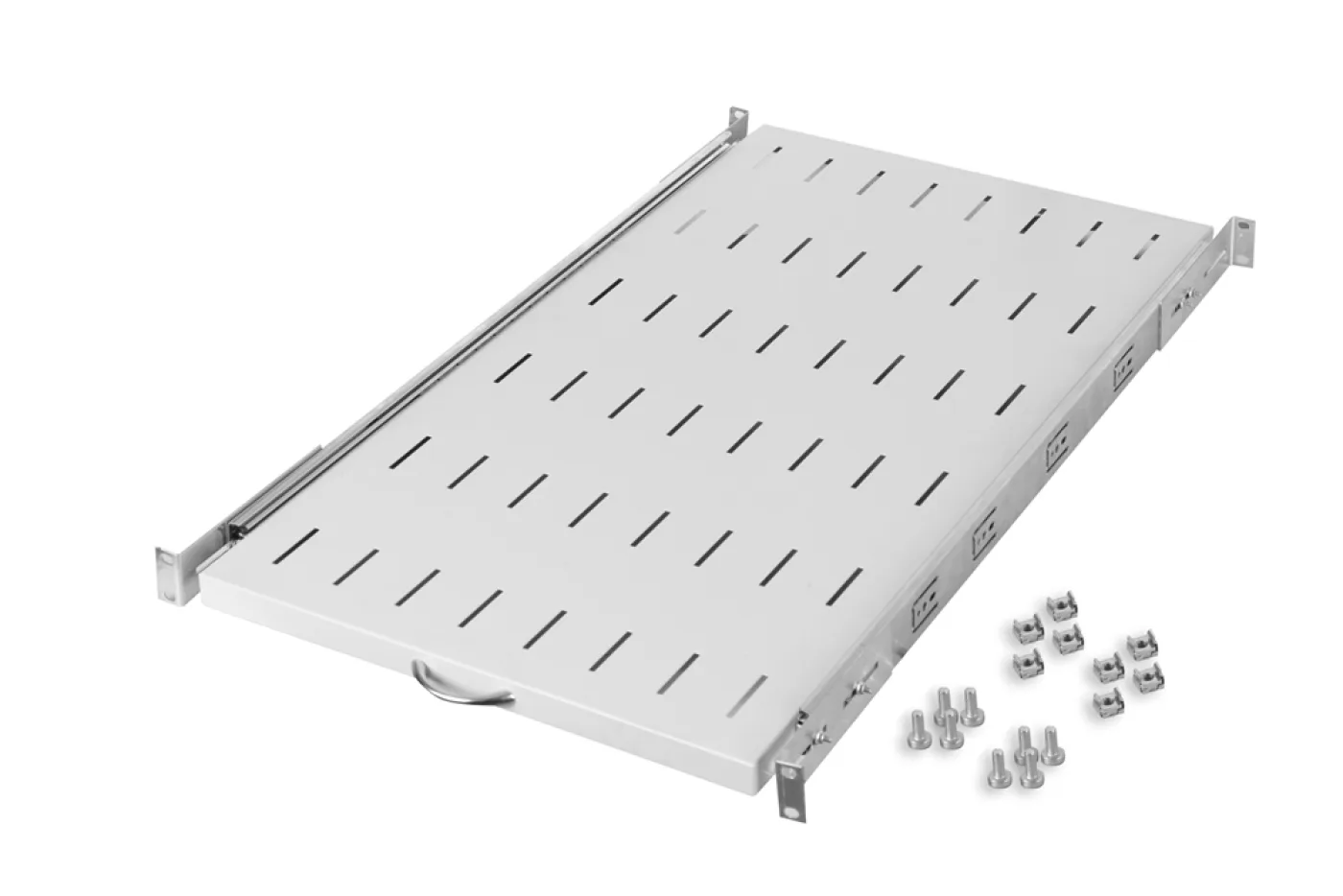
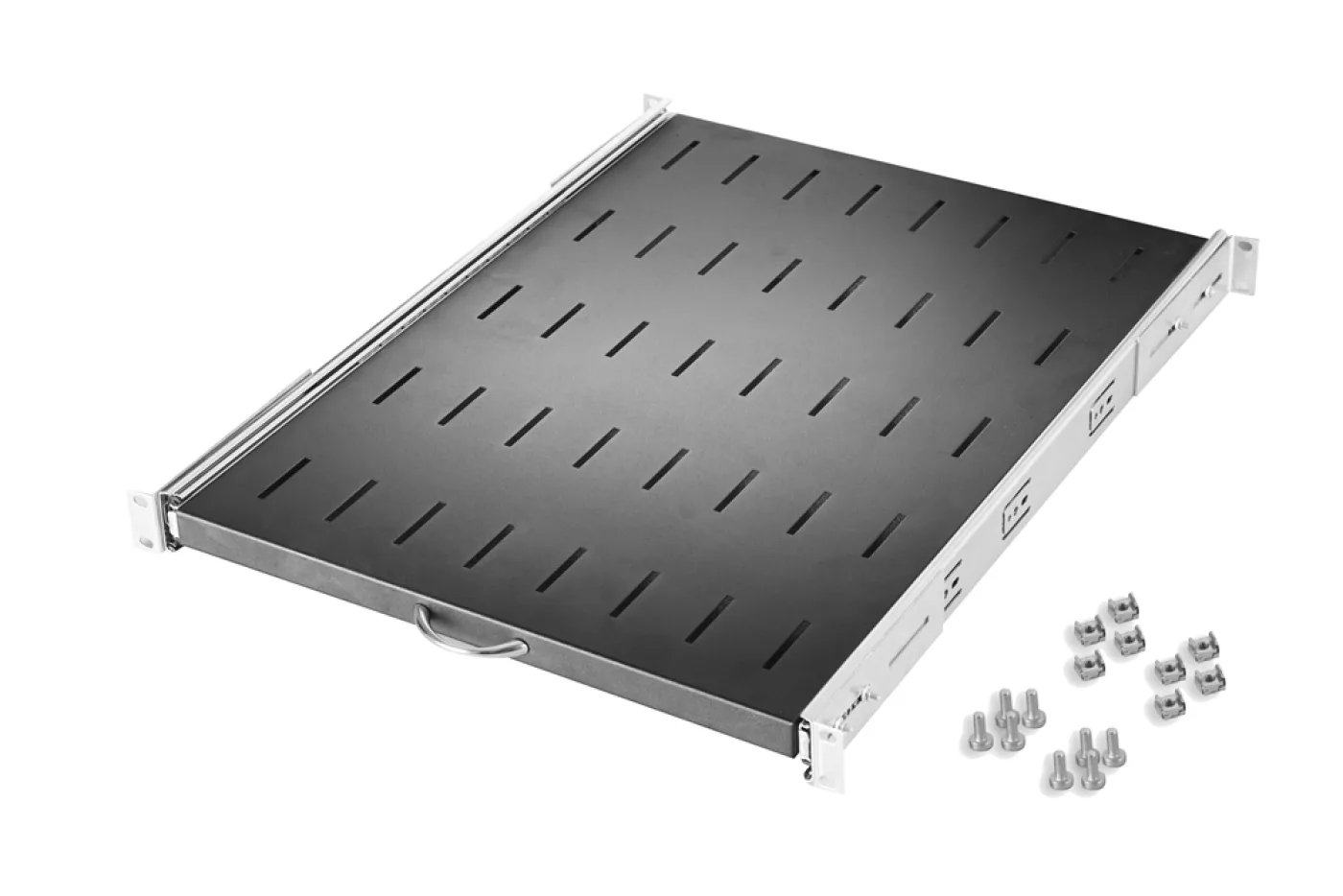
It bolts at four corners like a fixed shelf, but the shelf surface pulls forward on telescopic rails. Where you have to reach the back of something — change a cable, fit a disk, press a button — you get to it without dismantling the cabinet.
Where it is right: for equipment that is serviced often, for a keyboard and screen position, and in cabinets with tight rear access. Produced in 400, 600 and 800 mm depths.
One detail must not be skipped with a sliding shelf: when it is pulled out, the centre of gravity moves forward. On castors and unanchored, a loaded sliding shelf creates a tipping risk. Anchor floor-standing cabinets to the floor or to the row.
How to choose the depth
It has to satisfy two rules at once:
- Deeper than the device. A shelf shorter than the equipment going on it leaves that equipment hanging in the air.
- Shallower than the cabinet. Room has to remain behind the shelf for cable, and the rear door has to close. A 600 mm shelf does not go in a 600 mm cabinet.
A practical approach: cabinet depth minus roughly 150 mm. In an 800 mm cabinet, a 600 mm shelf is usually right.
| Cabinet depth | Typical shelf depth |
|---|---|
| 450 mm (wall-mount) | 300 mm cantilever |
| 600 mm | 400 mm |
| 800 mm | 500–600 mm |
| 1000 mm | 600–800 mm |
Do not guess the load rating
Shelf capacity depends on sheet thickness, the geometry of the folds and the attachment type; it cannot be read off the depth. If a UPS, a battery or any heavy device is going on it, read the load figure from that product's datasheet, and spread the load towards the posts rather than concentrating it in the middle of the shelf.
Mounting: cage nuts and M6
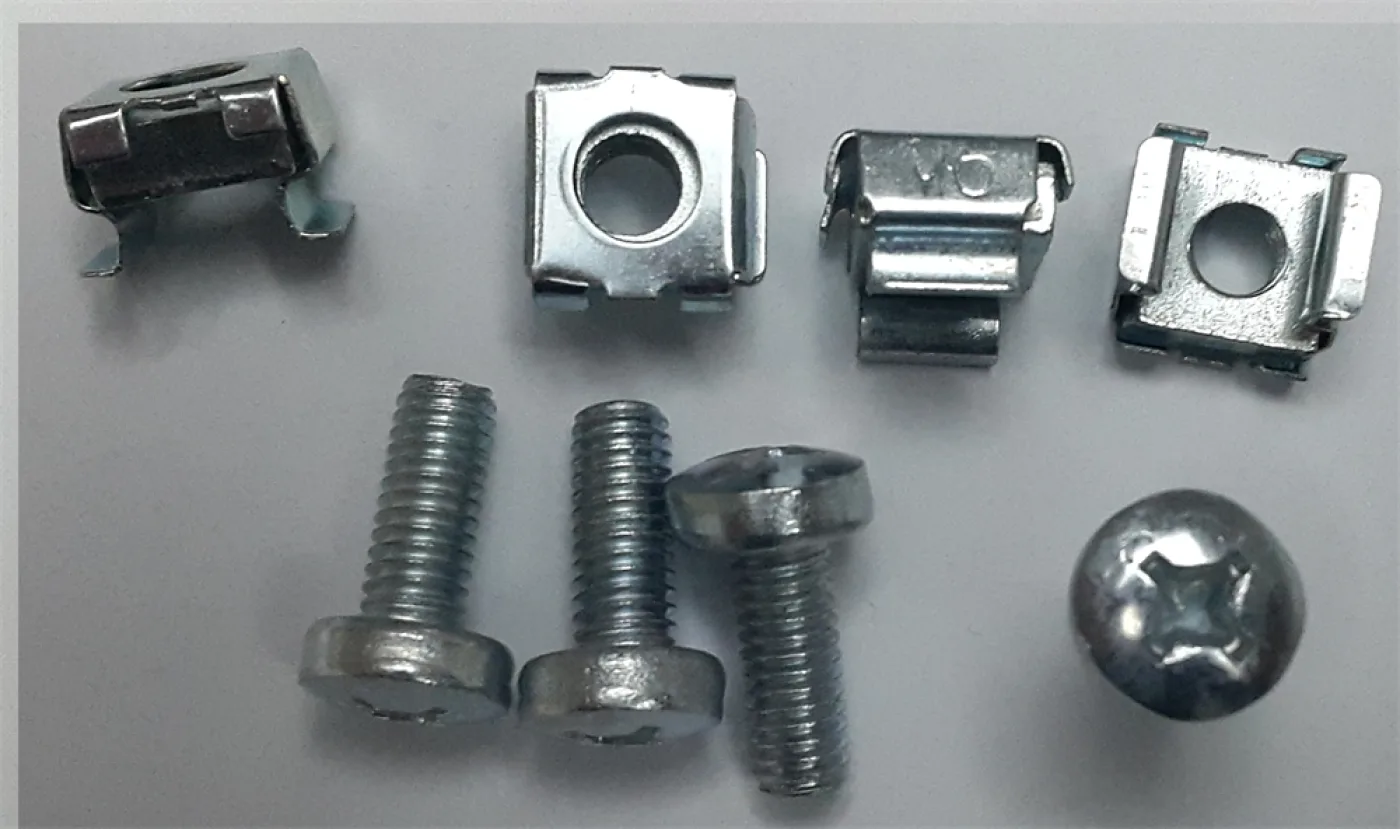
19-inch cabinets have square-holed posts and the attachment is made with a cage nut and an M6 screw. Nothing screws in directly. Three things make fitting cage nuts easier:
- Place the nuts beforehand, not while holding the shelf up.
- Make sure all four corners sit on the same U line; one hole out and the shelf is twisted.
- Use plastic washers — the post paint is not scratched and the shelf stays where it was set.
Our catalogue carries a ready-made cage nut and screw set for this; adding it to a shelf order is cheaper than hunting for missing screws on site.
Colour has a practical meaning
Shelves are produced in black and white. That is not only aesthetic: a light-coloured shelf reflects light inside the cabinet and makes cable labels easier to read when you are working with a torch. In a dark field cabinet it is a noticeable detail.
A shelf costs a U — and blocks air
Every shelf takes at least 1U. Include that in your height calculation (see our article on how many U a rack cabinet should be). A solid shelf also partly blocks the vertical airflow inside the cabinet; in a cabinet producing real heat, choose a perforated shelf and close the empty U above it with blanking panels.
Summary
| Requirement | Shelf type |
|---|---|
| Shallow wall cabinet, light device | Cantilever |
| Heavy device, permanent installation | Fixed |
| Device whose rear is reached often | Sliding |
| Keyboard and mouse position | Sliding |
| Cabinet with no rear posts | Cantilever |